Alligator cracking
A web of connected cracks usually points to base fatigue. Sealing alone will not stop it; the failed area typically needs to be removed and patched.
Serving New Orleans, Louisiana & surrounding areas
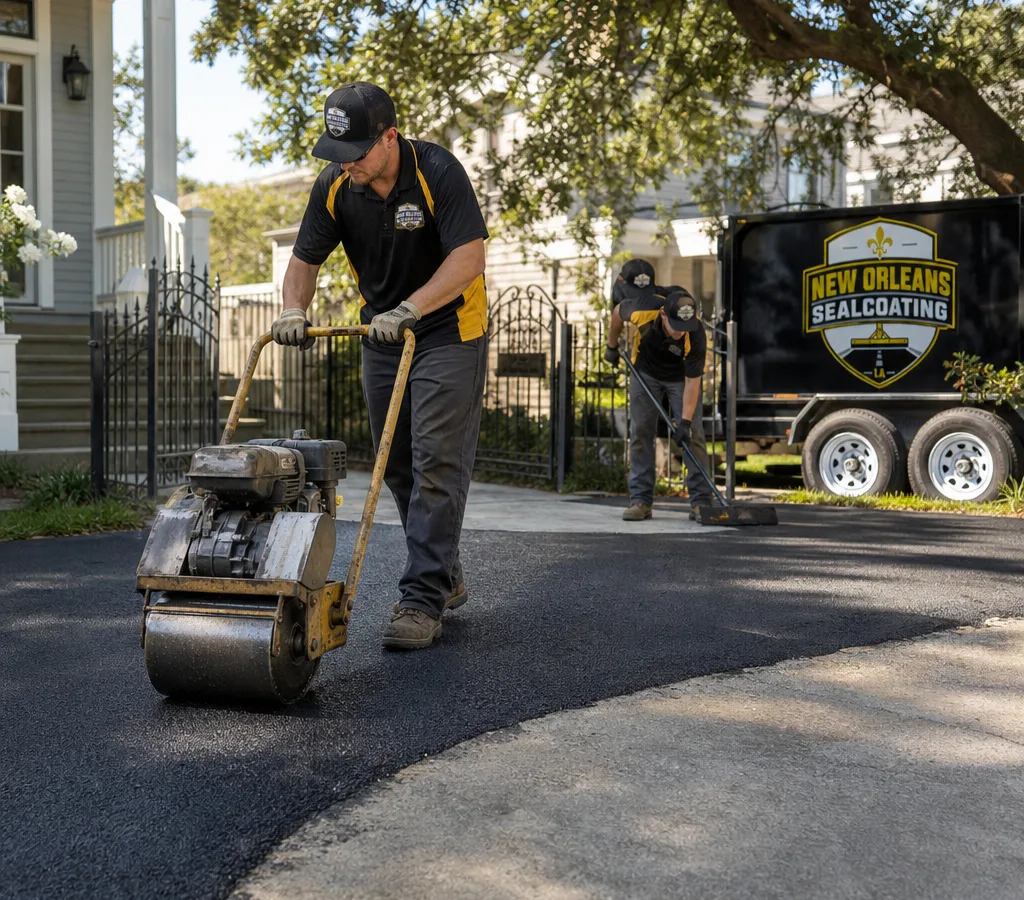
Fix potholes, crumbling edges, and sinking spots before they spread. Get a clear on-site assessment, a written scope, and repairs that hold up to New Orleans heat and heavy rain.
If you are searching for driveway repair New Orleans, you usually have one of a few problems: a pothole that keeps growing, a low spot that holds water after rain, alligator cracking that is turning into loose pieces, or driveway edges that are breaking away under tire traffic.
New Orleans Sealcoating handles asphalt repair for residential driveways and commercial pavement where targeted repairs make sense. The goal is simple: stabilize the base where needed, remove failed asphalt, rebuild the area with proper thickness, and compact it so it performs like pavement again.
Because New Orleans sees intense rainfall and long hot stretches, weak areas fail fast. Water works into cracks, softens the underlying base, and traffic finishes the job. Timely pavement repair in New Orleans is often the difference between a straightforward patch and a much larger tear-out.
You will find us at 1440 N Dorgenois St, Suite 4, New Orleans, LA 70119, and we schedule repairs across the city based on access, condition, and what will actually last on your site.
Good repairs start with choosing the right method for the failure. Some surfaces need a clean cut and full-depth patch. Others need localized leveling, edge rebuilds, or crack and surface prep ahead of protective sealing.
Common driveway and pavement repair work we perform includes:
For properties that want longer-term protection after repairs, our team also provides asphalt sealcoating in New Orleans once the pavement is structurally sound.
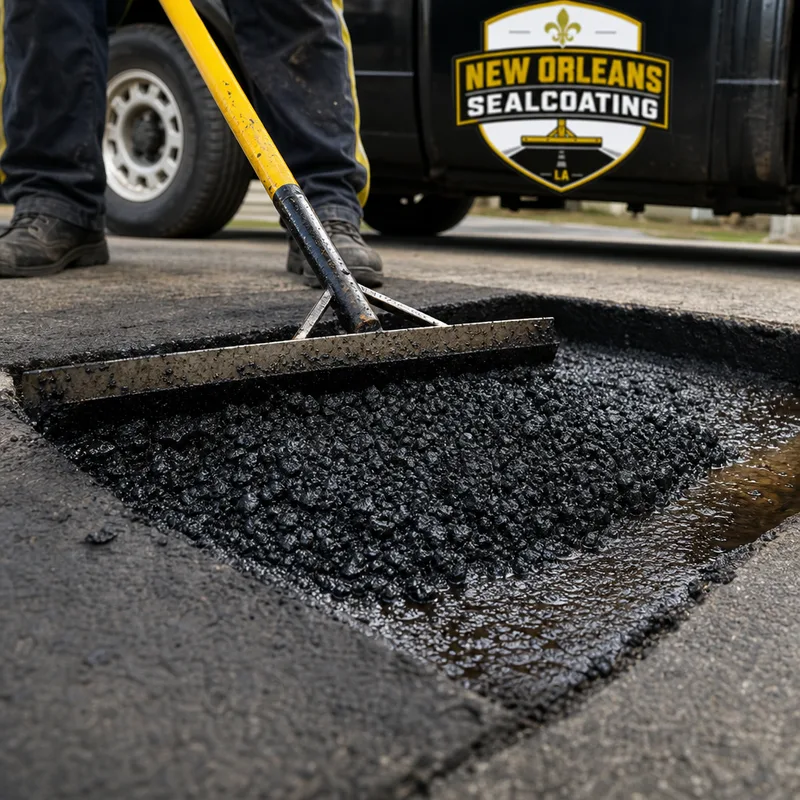
Cracking, loose aggregate, pooling water, and failing edges point to different underlying problems. Proper preparation matters because sealing over structural damage will not stop movement below the surface.
Book Your Free InspectionA web of connected cracks usually points to base fatigue. Sealing alone will not stop it; the failed area typically needs to be removed and patched.
When the surface is shedding stone, the asphalt binder is breaking down. Repairs may include patching the worst spots and restoring the surface before protective maintenance.
A patch that keeps popping out often means the edges were not cut cleanly, the base was soft, or the material was not compacted correctly.
Pooling can come from settlement, poor slope, or a patch that was not matched to surrounding grades. Fixing drainage flow early helps prevent deeper failures.
Edges break down where there is no support or where vehicles run off the pavement. Rebuilding edges protects the rest of the driveway from unraveling.
We identify the cause, remove failed material, correct the base where needed, compact new asphalt, and leave clear guidance for access and maintenance.
Book Your Free InspectionWe look at the failure pattern, traffic use, and water flow. Then we recommend repair options that make sense for the condition, not a one-size plan.
Failed asphalt is removed back to sound material. If the base is soft or pumping, we address it before new asphalt goes down so the repair does not sink.
We place asphalt to the needed thickness and compact in lifts, paying close attention to edges and transitions where patches often fail first.
We shape repairs to blend into surrounding pavement and reduce low spots that hold water after storms.
After repairs cure, we can outline an asphalt maintenance plan for crack control and surface protection so your pavement stays in good shape longer.
Driveway repair in New Orleans typically ranges from about $350 to $1,500 for small patching and pothole work, while larger areas or multiple failed sections often land around $2,000 to $7,500+. Pricing depends on how much asphalt has to be cut out, whether the base needs rebuilding, the thickness required, access for equipment, and how carefully the repair must be graded to avoid standing water. The exact cost is confirmed after an on-site assessment and a written scope for the repair areas.
Scheduling accounts for New Orleans rain, hot pavement, equipment access, and the time each repaired area needs before regular surface use resumes.
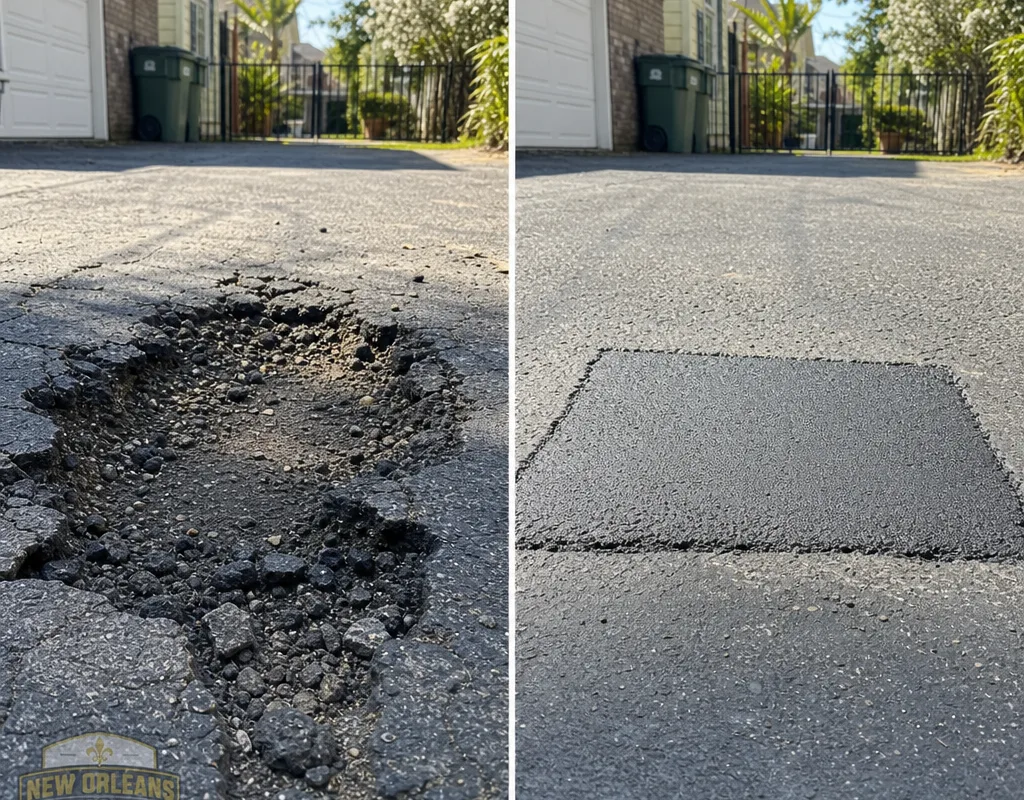
A surface patch addresses the top layer, while a full-depth patch removes failed asphalt down to the base and rebuilds the section. If you see alligator cracking, repeated potholes, or a spot that feels soft underfoot, full-depth asphalt patching is usually the repair that lasts because it fixes the structure, not just the surface.
Many asphalt patching jobs can be completed in a single visit, and light vehicle traffic is often possible the same day once the patch is compacted and cooled. Exact timing depends on patch size, site access, and how many repair areas are being addressed, so we confirm expectations during the on-site assessment.
Yes, if the pooling is coming from a low area that can be regraded or rebuilt, we can repair the spot to restore proper slope. If the problem is tied to broader drainage or multiple settled areas, we will spell out what can be corrected with patching and what may require a larger pavement maintenance plan.
Yes, we perform parking lot repair New Orleans property owners typically need, including pothole repair, patching of failed sections, and repairs at entrances and high-turn areas. For commercial sites, we also pay close attention to smooth transitions, drainage flow, and repair boundaries so the lot stays safer and easier to maintain.
Patching comes first for any area that is structurally failed; sealing a crack over broken pavement does not stop movement underneath. After patch areas are repaired and the surface is stable, targeted crack filling and asphalt maintenance help reduce water intrusion and slow the spread of future cracking.
Fast failures usually come from one of three issues: the repair was not cut back to solid edges, the underlying base stayed wet or soft, or the material was not compacted correctly. A durable pothole repair starts with removing the failed area completely, correcting the base when needed, and compacting the new asphalt in proper lifts.
Tell us what you are seeing and where it is happening. We will inspect the pavement, explain the best repair approach, and provide a written plan for asphalt repair, patching, or pothole work that fits your property.